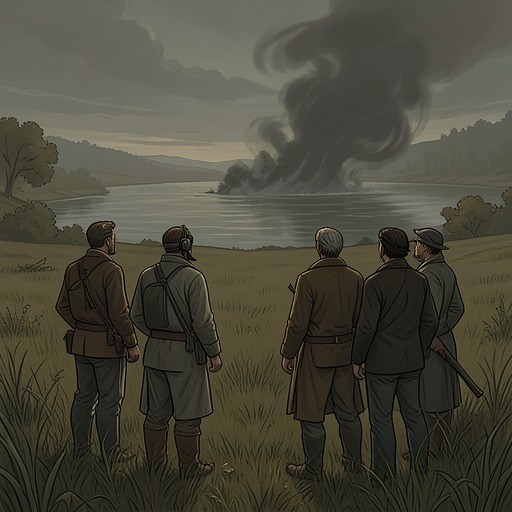
Passumpsic River
The Colour Out of SpaceThe Passumpsic River, in Caledonia County above Lyndonville, is one of three river locations tied to reports of bizarre objects in the floodwaters after the November 3, 1927 Vermont flood. The account makes the river significant not through a witnessed scene described in detail, but as one point in a cluster of reports that unsettles the boundary between local legend and supposedly ordinary disaster evidence.
Setting and Place in the Reports
The Passumpsic is identified as the northernmost of three waterways connected to the rumors: one report was associated with the Winooski River near Montpelier, another with the West River in Windham County beyond Newfane, and the third with the Passumpsic above Lyndonville. The narrator’s review reduces numerous stray newspaper items and one story transmitted orally in a letter to these three apparent instances. In each, country people were said to have seen one or more disturbing objects in water surging down from the unfrequented hills.
The account does not assign a separate witness, precise encounter, or distinct description to the Passumpsic report. Instead, the river belongs to a shared pattern of sightings. The reported shapes were said to be pinkish, about five feet long, crustaceous, and equipped with large dorsal fins or membranous wings, articulated limbs, and a convoluted, antenna-covered form where a head might be. Those details characterize the reports collectively; the narrative does not confirm that every feature was observed at this particular river.
Flood Reports and Folklore
The rumors reached the narrator largely through newspaper cuttings, amid press coverage of hardship, suffering, and relief work following the flood. Their similarity to one another seemed striking, but the narrator initially treated the reports as products of inherited superstition: people, he reasoned, could have mistaken human or farm-animal bodies in the currents for something uncanny, with old stories supplying the fantastic details.
Those stories concerned a hidden race said to inhabit remote Vermont hills: deep woods, steep gorges, and high, little-visited slopes. Their traces were alleged to include claw-like marks in mud, stone circles, and caves blocked by boulders. Accounts of the beings commonly described huge, light-red, many-legged crabs with bat-like wings; some versions depicted them carrying objects or flying away from a lonely hill. This regional lore provides the imaginative background against which the flood reports, including the one associated with the Passumpsic, were first interpreted.
A Landscape Remembered Through Avoidance
The folklore was not only a collection of extraordinary creature stories. Later versions described strange voices imitating human speech, disappearances, and hermits or remote farmers suspected of having undergone a disturbing mental change. The beings were often said to leave people alone unless their privacy was violated, while some tales accused them of establishing secret outposts or approaching human settlements. These changing accounts made the hills seem at once avoidable and increasingly close to ordinary life.
According to the narrator’s account of Vermont custom, the stories faded during the nineteenth century as settlement patterns became established. People continued to regard certain hilly districts as unhealthy, unprofitable, or unlucky, but the fears behind those judgments were increasingly forgotten. The haunted places remained largely deserted through habit and economic custom as much as deliberate caution. The Passumpsic report therefore arises in a landscape where inherited warnings had largely receded from everyday explanation, yet could still be revived when the flood carried strange-looking forms into view.
Narrative Significance
The river’s role is deliberately limited and consequential: it anchors one rumor to a named, geographically specific place, but offers no independent proof of what the witnesses saw. The narrator’s skepticism rests on a plausible natural explanation and on the way folklore can shape perception; the reports’ resemblance to older stories, however, also makes them difficult to dismiss as wholly unrelated inventions. The Passumpsic becomes part of that unresolved tension between evidence and interpretation.
Later revelations about the extraordinary beings said to inhabit Vermont’s remote hills alter the broader context of the flood rumors, but do not retrospectively identify a particular Passumpsic sighting. The river remains a reported location rather than a confirmed site of an encounter. That distinction preserves the narrative’s method: local testimony, inherited legend, and material evidence accumulate unevenly, while the meaning of any single report remains less certain than the larger pattern.